
Trash Cabinet Size
A pull-out trash cabinet hides bins inside a base cabinet, but the bins have to be big enough for your household and the cabinet wide enough for the bins. Enter how many bags you fill now and how often you want to empty them, choose single or double bins, and the calculator suggests a bin capacity and the cabinet width that usually fits it — or checks the inside of an existing cabinet.
- Free to use
- No sign-up
- Runs in your browser
Trash cabinet size calculator
Kitchen Bin Planning Templates
Kitchen cabinet measurement worksheet, household waste audit, an Excel bin capacity and cabinet planner, and a cabinet layout grid.
- Measurement worksheet (PDF, DOCX)
- Waste audit (PDF, XLSX)
- Capacity planner (XLSX)
- Layout grid (PDF)
Formats: PDF, DOCX, XLSX. Instant download after payment (link valid 72 hours, up to 5 downloads). AI-assisted: the templates were drafted with AI help and reviewed and laid out before publishing.
$5.00 USD, one-time 4 files · about $1.25 each
- Instant download
- 7-day refund
- Secure checkout by Stripe
7-day money-back guarantee. Full refund within 7 days of purchase, even after you download.
Free sample: Cabinet Measurement Worksheet (PDF, 58 KB)
Full refund within 7 days — see the refund policy and license.
Free printables
Single sheets you can print right now, no sign-up. The full pack adds every sheet in one download plus the editable files.
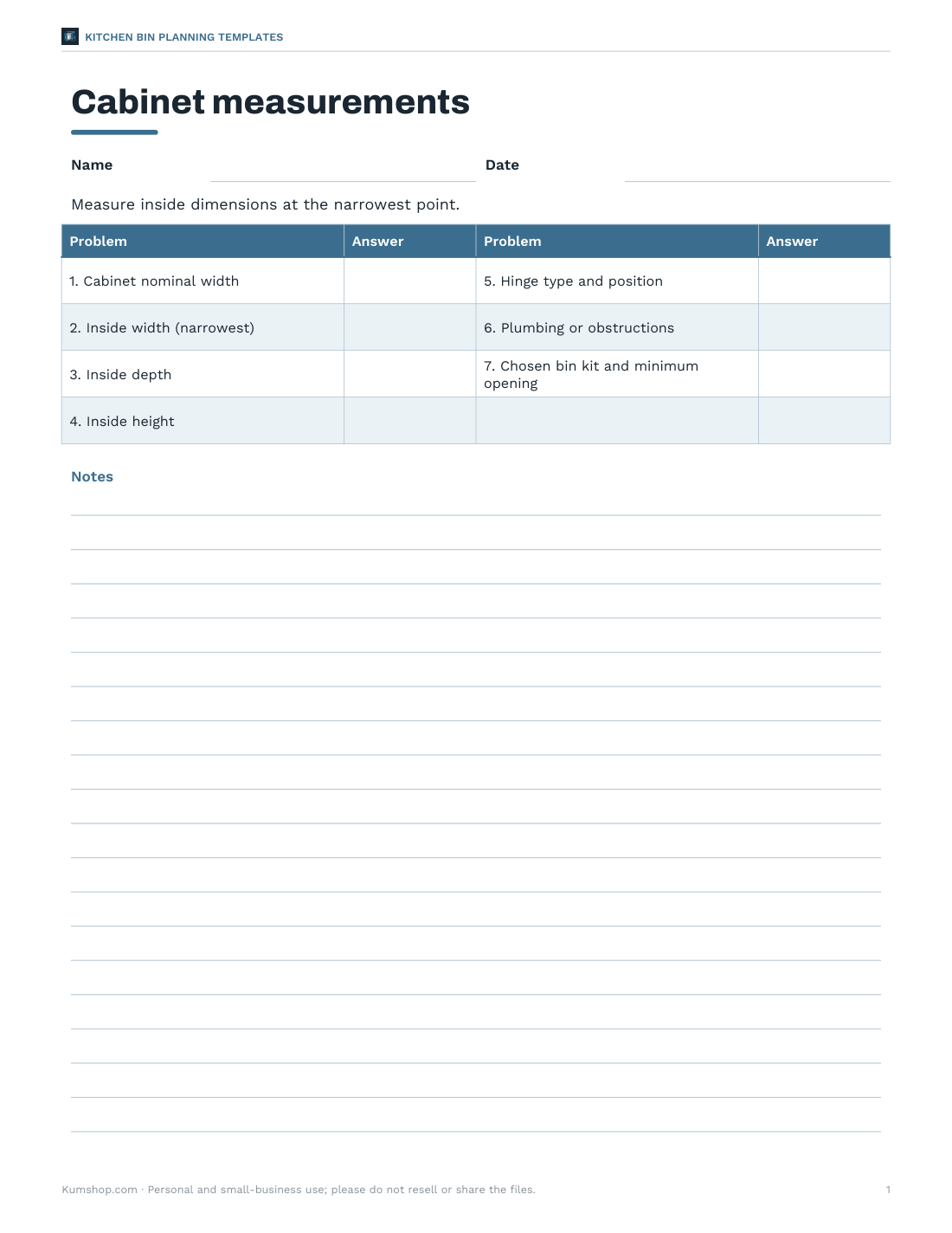
 Printable Cabinet Measurement Worksheet
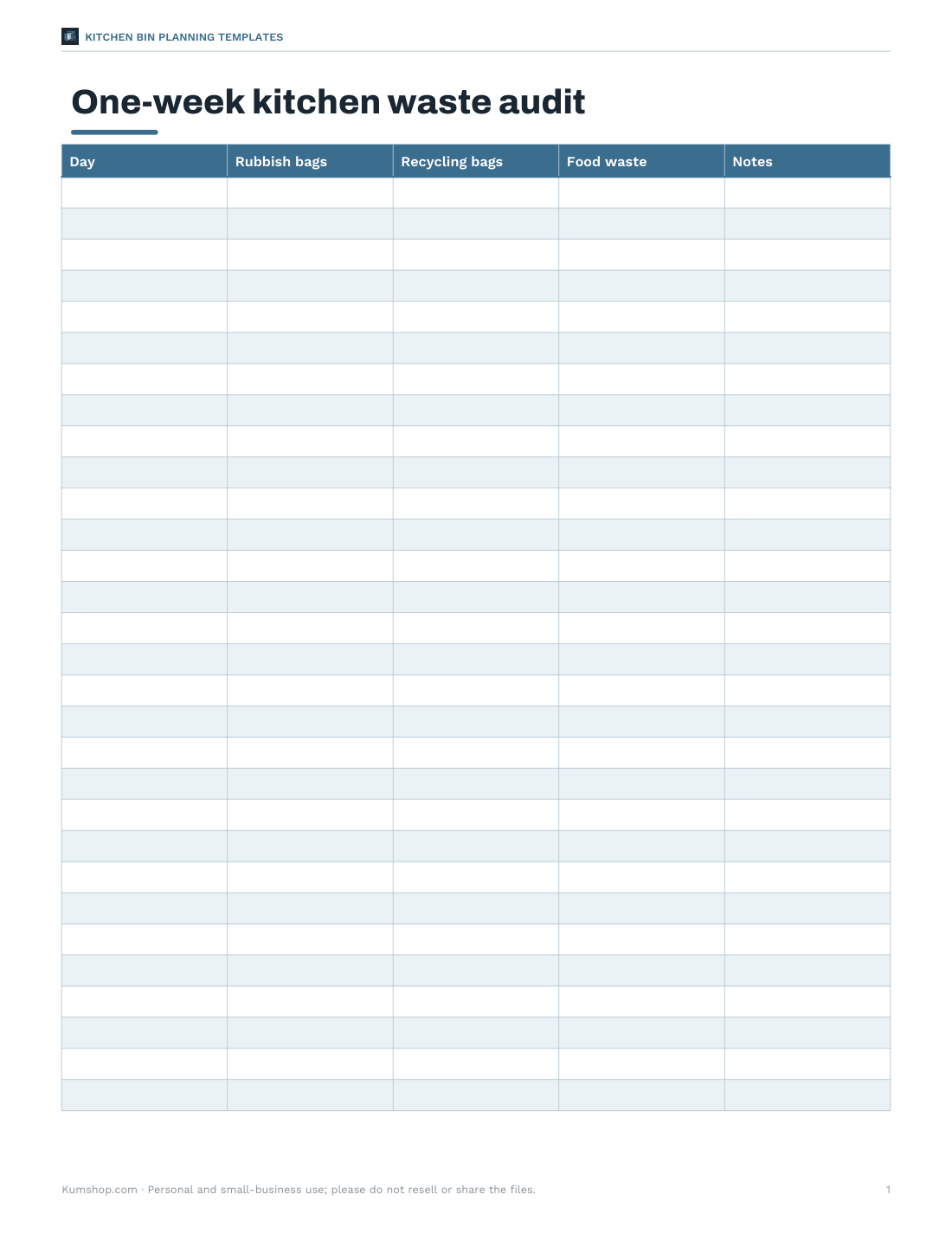
 Printable Kitchen Waste Audit Sheet
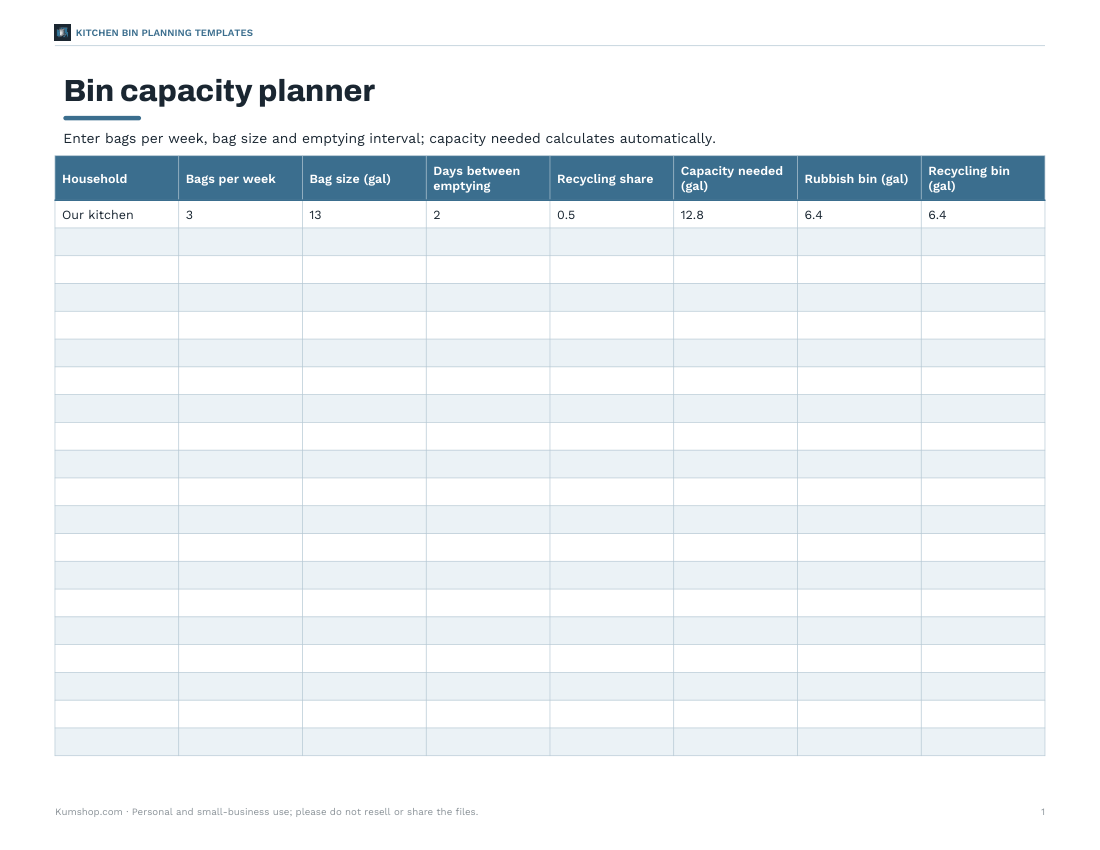
 Trash Bin Capacity Planner
 Printable Kitchen Cabinet Layout Grid
How the calculator works
- Your weekly kitchen waste = bags per week × bag size.
- Capacity needed = weekly waste ÷ 7 × days between emptying, plus 15% headroom so lids close.
- If you separate recycling, the capacity is split between two bins by the share you choose.
- It picks the smallest common pull-out setup that holds both, and shows the typical minimum inside width, depth and cabinet size for it.
- If you enter your cabinet’s inside dimensions, it checks which setups fit.
Bag and bin sizes are in US gallons; 1 US gallon is about 3.8 litres, and bins sold as quarts hold a quarter of a gallon per quart (35 qt = 8.75 gal).
Common pull-out bin setups
| Setup | Capacity | Typical cabinet width |
|---|---|---|
| Single 27 qt | 6.75 gal (26 L) | 12 in |
| Single 35 qt | 8.75 gal (33 L) | 15 in |
| Single 50 qt | 12.5 gal (47 L) | 15 in |
| Double 27 qt | 13.5 gal total | 18 in |
| Double 35 qt | 17.5 gal total | 18 in |
| Double 50 qt | 25 gal total | 21–24 in |
Base cabinets are usually made in 3-inch steps (9, 12, 15, 18, 21, 24 in and so on). The inside opening is smaller than the nominal width because of the cabinet sides and any face frame — often by 1.5 to 3 inches.
Worked example
A family of four fills three 13-gallon kitchen bags a week — 39 gallons — and wants to empty the bins every two days. That is about 12.8 gallons of capacity including 15% headroom. With about half going to recycling, each bin needs roughly 6.4 gallons, so a double 27-quart setup (two 6.75-gallon bins) fits in an 18-inch base cabinet. If they only empty every three days, the need rises to about 9.6 gallons per bin, and a double 50-quart setup in a 21- to 24-inch cabinet is the better choice.
Measuring an existing cabinet
- Open the door and measure the narrowest inside width — between hinges or the face frame, not the outside of the box.
- Measure the depth from the inside of the face frame to the back, noting any pipes.
- Measure the height from the cabinet floor to the underside of the countertop or drawer above.
- Compare with the minimum opening listed by the kit maker.
Sink base cabinets often have plumbing that blocks a full-depth pull-out; a door-mounted or under-sink bin may suit them better.
Where to put the trash cabinet
- Next to the sink or between the sink and the main prep area, where most scraps are made.
- Not directly next to the cooker, where heat and spills are a nuisance.
- With enough clearance to pull the bins fully out — about the depth of the cabinet in front of it.
- Consider a small caddy for food waste if your area collects compostables.
Top-mount, bottom-mount and door-mount bins
| Type | How it works | Good for |
|---|---|---|
| Bottom-mount slide | Bins sit in a frame on full-extension runners | Most new base cabinets; heavy loads |
| Top-mount slide | Frame hangs from runners at the top of the cabinet | Cabinets with a shelf or uneven floor |
| Door-mount pull-out | Frame attaches to the cabinet door so bins come out when you open it | Frameless cabinets; one-handed use |
| Door-hung bin | A small bin hangs on the inside of a door | Sink cabinets and small kitchens |
Soft-close runners and a lid mount that lifts as the drawer opens are worth considering if you use the bins many times a day.
Bin materials and cleaning
Plastic bins are light and easy to wash; steel bins look smart but dent. Choose bins with smooth insides and rounded corners that are easy to clean, and use liners that fit the bin size so they don’t slip. Wipe the runners and cabinet floor now and then — spills under the bins are the main source of kitchen smells.
Reducing kitchen waste
If the calculation suggests bins bigger than your cabinet, reducing waste is often easier than rebuilding: separate recycling, rinse and flatten cartons and boxes, compost food scraps, and buy fewer heavily packaged items. Flattened cardboard alone can halve the volume of recycling.
The printable kitchen planning templates
The template pack includes a kitchen cabinet measurement worksheet, a household waste and recycling audit sheet, an Excel bin capacity and cabinet planner, and a cabinet layout grid for sketching base units at ½ inch per foot — PDF, Word and Excel.
Frequently asked questions
What size cabinet do I need for a pull-out trash can?
Usually 15 in for a single 35–50 qt bin and 18 in for double 27–35 qt bins; 21–24 in for double 50 qt.
How many gallons is a 35 quart bin?
8.75 US gallons, about 33 litres.
What size trash can for a family of four?
It depends how often you empty it; many families use 13-gallon capacity or two 8–9 gallon bins with recycling.
Can a pull-out bin go under the sink?
Sometimes, if plumbing leaves enough depth; door-mounted bins are an alternative.
How do I measure the cabinet opening?
Measure the narrowest inside width between hinges or the face frame.
Are the kit sizes for a specific brand?
No, they are typical of common pull-out systems — check your kit’s instructions.
How much clearance do I need in front of a pull-out bin?
About the depth of the cabinet, roughly 22 inches, so the bins can come fully out.